Cat Breeds · large
Maine Coon: the giant American cat that weighs as much as a medium-sized dog
Natural breed from the northeastern United States. Massive body, semi-long water-resistant coat, and the sociable temperament that made it one of the most popular domestic cats in the world.
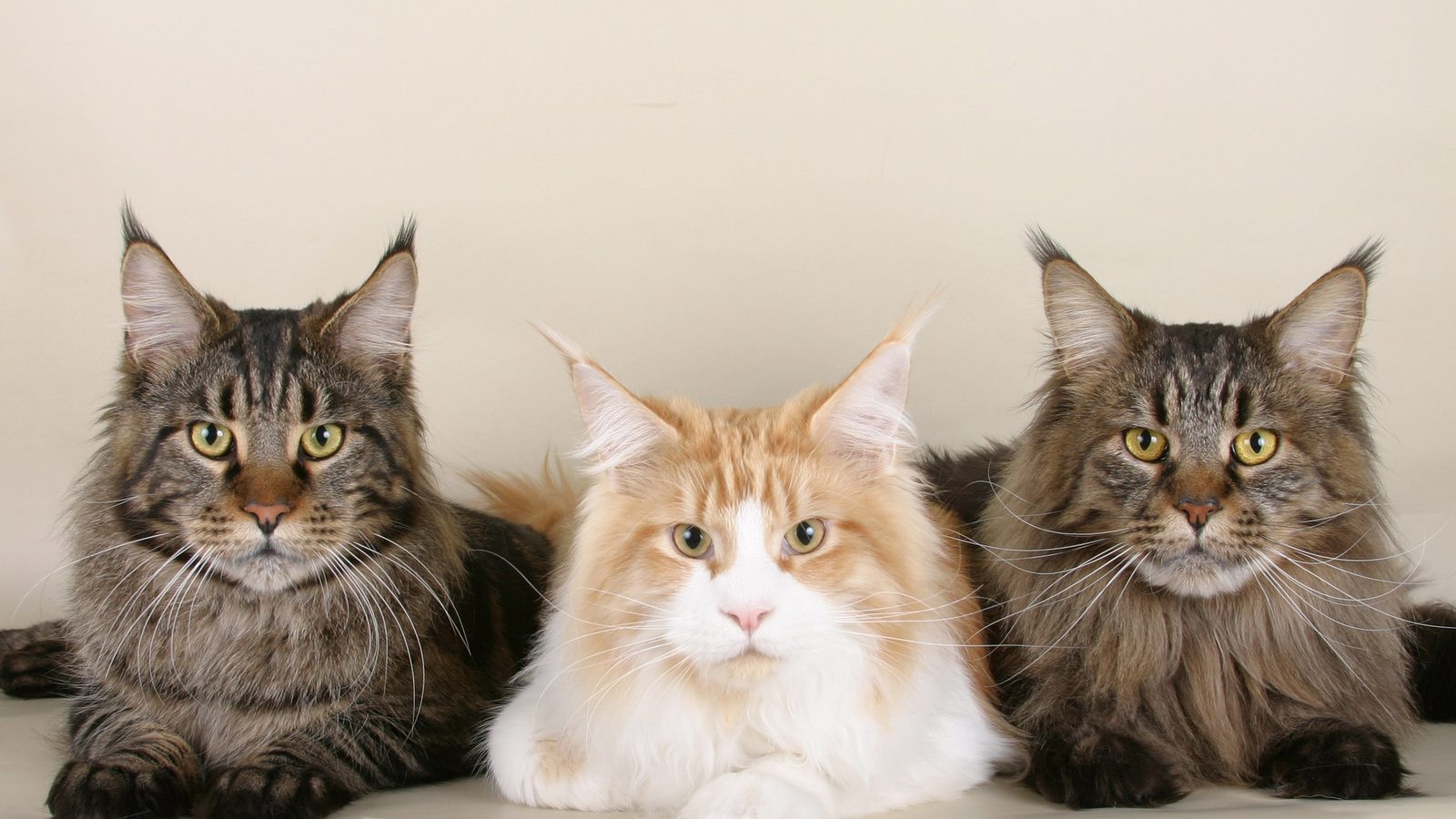
In the late 19th century, New England farmers organized cat shows where the "king" or "queen" of cats was crowned. The honor went almost always to the same type: a brown tabby with a semi-long coat, a long bushy tail, and a frame that crossed six kilograms (over 13 pounds) without effort. Those cats weren't the result of a breeding program; they had emerged on their own, adapting to northeastern winters over generations. When European cat fanciers landed in the United States decades later, that cat already had a name: Maine Coon.
Today, alongside the Persian and the Ragdoll, it's one of the most recognizable breeds in the world. It weighs as much as a small dog, purrs like an engine, and trills when it sees a bird through the window. They learn to open faucets.
Where the Maine Coon's name comes from
The first part refers to the state of Maine, where the first specimens were documented and where the breed was declared the official state cat in 1985. The second part is slipperier. The popular hypothesis is that it comes from "raccoon," because of the resemblance between the brown tabby coat and the brushy tail. Genetically, the breed shares nothing with raccoons, but the image stuck.
The most widely accepted theory of origin holds that they descend from longhaired cats brought by European sailors and settlers from around 1850. Those animals, crossed with local shorthaired cats, produced descendants adapted to the cold northeastern climate: a dense water-resistant coat, sturdy paws with furred footpads for walking on snow, and ears with insulating tufts. Natural selection, not human selection.
Why it's considered the largest domestic cat
By the numbers. An average adult male weighs 15 to 20 pounds (7-9 kg); some individuals exceed 24 pounds (11 kg). Females stay between 9 and 14 pounds (4-6.5 kg). Length from nose to tail tip is around 35 to 48 inches (90-120 cm), with the tail alone measuring up to 14 inches (35 cm). The Guinness record for longest domestic cat has been held by Maine Coons for many consecutive years.
Important: they're not enormous from kittenhood. They mature slowly, reaching full adult size between 3 and 5 years of age. Most cat breeds finish growing by 18 months; the Maine Coon keeps broadening shoulders and chest for twice that long.
What its temperament is actually like
Two traits define it, documented since the earliest American records: unusual sociability and distinctive vocal communication.
Sociability translates to following the human around the house without being clingy, tolerating children well, coexisting without drama with other household cats, and frequently with dogs too if introduced gradually. It's not the typical aloof cat. Closer to the "dog-like cat" profile breeders describe.
Vocal communication isn't the classic meow but rather trills, chirps, and warbles. If you've never heard a Maine Coon "talk," the first time is surprising: it sounds more bird-like than feline. They usually vocalize to get attention, not from stress.
Three nuances to be clear on before adopting:
- Not a permanent lap cat. It likes to be near you, not on top of you. Some do seek long contact, but most prefer parallel company.
- Needs cognitive stimulation. The breed's intelligence is documented in cats that open doors, work faucets, and carry objects in their mouths. Without enrichment, it turns into destructive mischief.
- Tolerates solitude well compared to more demanding breeds (Siamese, Burmese), but eight hours daily without stimulation wears on it over time.
What hereditary health issues it has
This is the part any serious breeder addresses head-on, because the breed has well-identified genetic pathologies with tests available for breeding stock.
Hypertrophic cardiomyopathy (HCM). The most common feline cardiomyopathy and the leading cause of sudden death in the breed. The heart muscle thickens, reducing ventricular cavity volume and compromising circulation. A genetic test (MYBPC3) identifies carriers before breeding. The prevalence of the mutation in untested lines has been estimated at around 30% in European and U.S. studies published in Journal of Veterinary Internal Medicine. Buying from a breeder who can't show the parents' tests is rolling the dice.
Hip dysplasia. Uncommon in cats overall, but documented in large breeds. OFA-style radiographic screening recommended in breeding stock.
Spinal muscular atrophy (SMA). Autosomal recessive neurodegenerative disease. A genetic test has existed since 2009. Affected kittens develop muscular weakness starting around 12 weeks. Not fatal but compromises quality of life.
Polycystic kidney disease. Less common than in Persians but present. Diagnosed by abdominal ultrasound in young adults.
Average life expectancy is 12-15 years with appropriate care. Healthy individuals without hereditary disease reach 17-18 without trouble.
Does the Maine Coon need a lot of grooming?
Less than the coat suggests. The outer coat is semi-long but doesn't easily mat because the double coat has a short inner layer that supports it. A reasonable protocol:
- Brushing 2-3 times a week with a deshedding brush for long-haired cats or a wide-tooth comb.
- Daily brushing during seasonal sheds (spring and fall), which are intense in this breed.
- Bath every 2-3 months with a shampoo formulated for double coats.
- Attention to the neck ruff and base of the tail: the spots where tangles appear first.
The ears, with their characteristic tufts, need no special care beyond monthly routine cleaning. Furred footpads should be checked in summer for debris.
Does it adapt well to apartment life?
Yes, with conditions. It's not a cat that needs acres: it needs interior space and environmental enrichment, not open fields. What it does need:
- Tall vertical scratching posts (at least 5 feet / 1.5 m). It's the breed with the most muscle and loves to stretch upward.
- Elevated resting zones: shelves, cat trees, ledges.
- Automatic interactive toys that substitute simulated hunting. Uncanalized intelligence and mental energy turn into chewing on cables or stealing small objects.
- Access to running water or a fountain: documented preference for moving water. Many Maine Coons play with water, dip a paw in the bowl, or drink directly from the faucet.
It's one of the breeds with the best track record in families with children and other animals. Patience with children is high, and coexistence with calm dogs usually works without conflict, especially if introductions are done before the kitten is six months old.
How much should a Maine Coon eat?
More than an average cat, naturally: a ration of 2-3 oz (55-90 g) of premium dry food per day depending on weight and activity, split into 2-3 meals. Kittens and juveniles (up to 12-15 months) should have 3-4 meals and a large-breed-specific kitten food with controlled calcium-phosphorus ratio.
Overweight is a real problem in the breed, especially in spayed/neutered sedentary adults. Every extra pound on an already-heavy skeleton accelerates osteoarthritis and stresses the heart. Weigh the cat every 2-3 months and adjust the ration.
Three nutritional keys for the breed:
- High animal protein (35-45% in dry food), because the Maine Coon builds muscle mass for 4 years.
- Large kibble size, adapted to its jaw. Small kibble for average cats gets swallowed whole.
- Omega-3 intake (EPA and DHA) for combined cardiac and joint benefits.
How much does a Maine Coon cost in the United States?
A kitten with pedigree, genetically tested parents (HCM, SMA, PKD), and early socialization costs between $1,500 and $3,500 in 2026 from a CFA- or TICA-registered breeder. Show lines with championship parents reach $3,500-6,000.
What you pay for under $800 in a private sale without documentation: absent tests, high probability of hereditary cardiac disease, possible undocumented crosses. The initial saving translates into cardiac surgery or early death in many cases.
Maine Coon data sheet
Identification
- Size: large (one of the largest documented domestic cats)
- Weight: 12-24 lb males / 9-14 lb females
- Length: 35-48 in nose to tail tip
- Life expectancy: 12-15 years (up to 17-18 with optimal care)
Physical
- Coat: semi-long, dense, double, water-resistant
- Colors: wide palette (brown tabby, silver, solids, particolor, calico)
- Ears: large, wide-based, tufted at the tip
- Tail: long, bushy, brush-shaped
- Footpads: tufted between toes, cold-climate adaptation
Temperament
- Sociability: high with humans, children, and other animals
- Independence: medium; seeks company without being clingy
- Vocalization: soft trills and chirps, rarely loud meows
- Trainability: one of the most trainable cat breeds for basic cues
Care
- Brushing: 2-3 times a week outside shed; daily during shed
- Exercise: needs vertical space and daily play
- Diet: large-breed premium kibble, ration adjusted
Is this breed for you?
Yes, if you live in housing with reasonable space, you value active coexistence with your cat, and you accept the commitment of genetically testing your kitten's line. Yes, too, if you want a cat with a more sociable profile than average, capable of following you around the house without being intrusive.
No, if your home is a tiny apartment without room for vertical enrichment, if you're away more than ten hours a day, or if your budget doesn't include the real cost of a tested kitten (minimum $1,500) plus annual veterinary follow-up (cardiac screening included).
Frequently asked questions
Is the Maine Coon good with children? Yes. It's one of the breeds with the highest documented tolerance for noise and child handling, always with supervision and respect for the cat's space.
Does it get along with dogs? Yes, especially if introductions are done before the kitten is six months old. Its sociable temperament makes integration with calm dogs straightforward.
How long does it take to reach adult size? Between 3 and 5 years. It's the cat breed with the longest physical maturation.
Is it the breed with the highest HCM prevalence? It's one of the most studied because of the MYBPC3 mutation prevalence, but genetic tests are available. Buying from a breeder who can show negative tests in both parents drastically reduces the risk.
Does it need outdoor access? No, if the interior has adequate enrichment (tall scratching posts, interactive toys, elevated zones). Harness walks or enclosed "catio" outdoor space are optional and enriching.
Does it shed a lot? Moderate outside of shedding season. Intense for 3-4 weeks in spring and fall. House vacuuming becomes weekly at minimum.
Bibliography
- The Cat Fanciers' Association (CFA), Official Breed Standard: Maine Coon. https://cfa.org
- The International Cat Association (TICA), Maine Coon judging criteria and genealogical registry. https://tica.org
- Meurs, K.M. et al. (2005). A cardiac myosin binding protein C mutation in the Maine Coon cat with familial hypertrophic cardiomyopathy. Human Molecular Genetics, 14(23).
- International Society of Feline Medicine, clinical guidelines on HCM in cats.
- Royal Veterinary College, VetCompass studies on hereditary pathology prevalence in cat breeds.
Sources
- The Cat Fanciers' Association (CFA), Official Breed Standard: Maine Coon
- The International Cat Association (TICA), Maine Coon Breed Group standard and registry
- Meurs, K.M. et al. (2005). A cardiac myosin binding protein C mutation in the Maine Coon cat with familial hypertrophic cardiomyopathy. Human Molecular Genetics, 14(23)
- American Veterinary Medical Association, clinical resources on feline HCM
- Royal Veterinary College, VetCompass studies on hereditary disease prevalence in cat breeds